
Fly fishing carries a reputation for being difficult, expensive, and exclusive. In reality, the basics are accessible to anyone willing to spend a few hours practicing in a park or backyard before hitting the water. This guide will walk you through everything you need to get started: gear selection, understanding the river, basic casting, and choosing the right flies.
How Fly Fishing Differs from Conventional Fishing
In conventional fishing, the weight of the lure or sinker carries the line to the target. In fly fishing, the weight of the line itself carries the nearly weightless fly to the target. This fundamental difference is why fly fishing requires a different casting technique — you're loading the rod with the weight of the line, not the lure.
The result is a presentation that is uniquely delicate: a dry fly landing softly on the surface, imitating a real insect. This natural presentation is often the only way to fool selective trout in clear, calm water.
Essential Fly Fishing Gear
The good news for beginners: a quality entry-level fly fishing setup is more affordable than ever. Here's what you need to get started:
Rod, Reel, and Line
For trout fishing, a 9-foot, 5-weight rod is the universal starting point. The "weight" refers to the line weight the rod is designed to cast — a 5-weight is versatile enough to handle small streams up to larger rivers with a single-handed rod. Most manufacturers sell starter kits (rod + reel + line + leader) that remove all the guesswork.
| Rod Weight | Best For | Typical Fish |
|---|---|---|
| 2–3 weight | Small brooks, tight streams | Small trout, panfish |
| 4–5 weight | General trout streams & rivers | Trout, bass, panfish |
| 6–7 weight | Larger rivers, streamers | Large trout, bass, pike |
| 8–10 weight | Saltwater, big rivers | Salmon, steelhead, bonefish |
The Leader and Tippet System
The leader is a tapered, transparent monofilament or fluorocarbon line that connects your fly line to your fly. It gradually tapers from thick to thin, which transfers casting energy smoothly and allows the fly to land softly. A 9-foot, 4X or 5X leader is a great starting point for dry fly fishing.
The tippet is additional, thin material you add to the end of the leader as it gets shortened from changing flies. Tippet size is indicated in "X" ratings — the higher the X number, the thinner and lighter the tippet (4X = 6 lb, 5X = 4.5 lb, 6X = 3 lb).
Reading the River
Trout live where three things overlap: oxygenated water, food delivery, and shelter from current. Learn to identify these spots and you'll always know where to cast:
- Riffles: Shallow, fast water over rocks. Highly oxygenated — great for feeding trout and nymphing.
- Runs: Deeper, moderately paced water between riffles and pools. Often holds the largest fish.
- Pools: Deep, slow water. Trout rest here but may not be actively feeding. Fish the head and tail of pools.
- Seams: The line where fast current meets slow current. Insects drift along seams — trout position here to intercept them with minimal effort.
- Undercut banks and boulders: Excellent shelter spots, especially for large fish.
The Basic Fly Cast
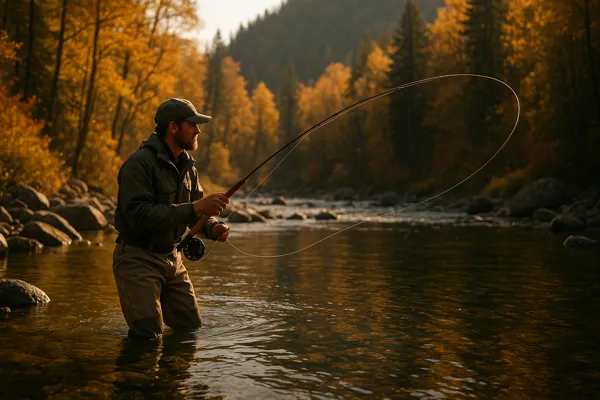
The overhead cast is the foundation of fly casting. The essential principle: let the fly line fully load (bend) the rod on both the back cast and the forward cast before applying power. Rushing the cast — starting the forward motion before the back cast fully unfolds — is the most common beginner mistake.
Practice on grass before you fish. Lay out 20–25 feet of line and focus on a smooth, crisp stop at the 10 o'clock position (back cast) and 2 o'clock position (forward cast). The line will do the work if you let it.
Choosing Your First Flies
Fly selection can be overwhelming, but beginners don't need more than a handful of patterns to start. Focus on these versatile, proven patterns:
- Elk Hair Caddis (#14–18): One of the most universally effective dry flies for trout across North America.
- Parachute Adams (#14–18): Imitates a wide range of mayflies; works year-round on most streams.
- Pheasant Tail Nymph (#14–18): The best nymph for beginners — imitates the nymph stage of many mayflies.
- Hare's Ear Nymph (#12–16): A catch-all nymph that imitates various aquatic insects.
- Woolly Bugger (#6–10): A streamer that imitates baitfish and large invertebrates — great for aggressive fish.
"The best advice I ever got was to watch the water for 10 minutes before making a single cast. See what insects are hatching, where the fish are rising, and how the current flows. Then fish with purpose." — A principle echoed by experienced fly fishers everywhere.
Fly fishing rewards patience and observation more than any other form of angling. Start with a simple setup, learn to read one stretch of water deeply, and the rest will follow naturally.