

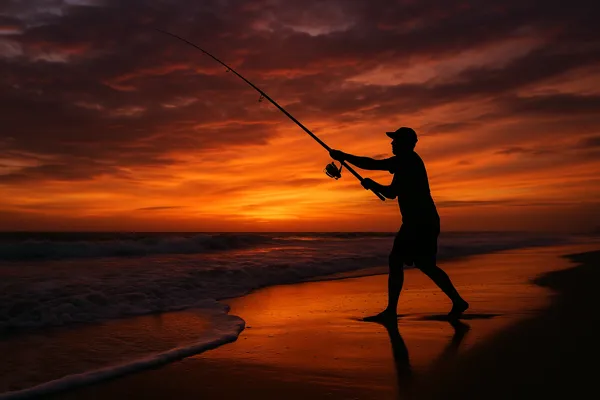
Surf fishing is one of the most accessible forms of saltwater fishing — you need no boat, no captain, and no dock access. Just a rod, some gear, and miles of productive coastline. Species like striped bass, bluefish, red drum, pompano, and flounder can all be caught from the beach, and for many anglers, the combination of crashing waves and wide-open sky makes surf fishing one of the most rewarding fishing experiences available.
Understanding the Surf Zone
Before you can consistently catch fish from the surf, you need to understand how the ocean interacts with the shoreline. Fish don't distribute themselves randomly along the beach — they concentrate in specific areas where currents and structure create feeding opportunities.
Reading the Beach
The most important skill a surf angler can develop is reading beach topography. Walk the beach at low tide and you'll see features that are invisible at high tide:
- Troughs: Deeper channels running parallel to shore just inside the outer sandbar. Fish use these as travel lanes and feeding corridors. They appear as darker, greenish water.
- Cuts and rips: Channels cutting through sandbars where water rushes back to sea. These concentrate baitfish and attract predators. Look for discolored or churning water moving seaward.
- Points and jetties: Physical structures that create eddies and current breaks. Fish hold on the downcurrent side.
- Beach structure: Rocky sections, submerged reefs, and mussel beds visible at low tide all hold fish at higher water stages.
Surf Fishing Gear Essentials
The Surf Rod
Surf rods are purpose-built for distance casting and handling strong fish in rough conditions. For beginners, a 10–12 foot, medium-heavy surf rod is the right starting point. This length provides the casting arc needed to punch through wind and launch a bait beyond the breaking waves where fish feed.
Pair your surf rod with a large spinning reel in the 6000–8000 size range, capable of holding 200+ yards of line. In the surf, fish often make long runs, and running out of line is a real possibility with a reel that's too small.
Line and Rigging
Most surf anglers use 20–30 lb braided line as their main line, with a 20–30 lb monofilament or fluorocarbon shock leader. The braid provides sensitivity and no-stretch strength for long-range hooksets; the leader provides abrasion resistance against the rough surf and sand.
| Target Species | Main Line | Leader | Best Bait |
|---|---|---|---|
| Striped Bass | 30 lb braid | 30 lb fluoro | Bunker chunk, sand eel |
| Red Drum | 20–30 lb braid | 30 lb mono | Crab, cut mullet |
| Bluefish | 20 lb braid | Wire or heavy fluoro | Metal lures, cut bait |
| Pompano | 15–20 lb braid | 15 lb fluoro | Sand fleas, shrimp |
| Flounder | 15 lb braid | 15 lb fluoro | Bucktail jig with plastic |
The Fish-Finder Rig
The most universally effective surf fishing rig is the fish-finder rig (also called a Carolina rig). A sliding sinker (pyramid sinkers grip sand best in current) runs on the main line above a swivel, with a 12–24 inch fluorocarbon leader and a circle hook attached. The sliding weight keeps the bait on the bottom while allowing a fish to pick up the bait without feeling resistance. Circle hooks are strongly recommended — they significantly reduce gut-hooking and hook up securely with a steady reeling motion rather than a sharp hookset.
Timing the Tides
Tidal movement is the engine of surf fishing. Understanding how tides affect fish behavior is the fastest way to improve your results. As a general rule:
- The incoming tide floods baitfish into the surf zone and pushes feeding fish closer to shore — often the most productive period.
- High tide gives predators access to areas that were dry or too shallow at low water.
- The outgoing tide rips food out through cuts and rips — fish stack at the mouths of these outflow channels.
- Low tide is typically the least productive for surf fishing, but it's the best time to read the beach and identify structure.
Target the two hours before and after high tide for most species. Download a free tide chart app for your area and plan your sessions around tidal movement rather than convenience.
Dawn, Dusk, and After Dark
Like most saltwater predators, striped bass, red drum, and bluefish feed most actively in low-light conditions. The hour before sunrise and the hour after sunset consistently produce the best surf fishing action. Night fishing the surf is a dedicated pursuit that regularly yields the largest fish, particularly for stripers along the northeastern coast. Bring a headlamp, dress warmly, and always let someone know where you're fishing when you go out after dark.
The surf is a dynamic, ever-changing environment — conditions vary by tide, season, weather, and baitfish migration. Keep a fishing log noting conditions when you catch fish, and over time you'll build a detailed picture of when and where your local surf is most productive.